
What Does High Cholesterol Mean? Understanding the 4 Numbers on Your Lipid Report
TL;DR
- High cholesterol does not mean you already have cardiovascular disease, and risk cannot be judged from total cholesterol alone.
- A lipid report should be read as a whole — total cholesterol, LDL-C, HDL-C and triglycerides — in the context of your overall cardiovascular risk.
- LDL-C is an important causal factor in atherosclerotic cardiovascular disease, but management targets differ from person to person.
- A high HDL-C cannot offset LDL-C or other risk factors, and lipid abnormalities often have no symptoms early on.
- Whether lipid-lowering medication is needed is a doctor's decision; if you are already taking it, do not stop just because a result has returned to normal.
Contents
- Does high cholesterol mean your blood vessels already have a problem?
- What do the 4 numbers on a lipid report mean?
- Can you feel high cholesterol?
- Why has my cholesterol gone up?
- With high cholesterol, can you no longer eat egg yolks, meat and seafood?
- Does high cholesterol always need medication?
- Beyond LDL, what else is worth looking into?
- A reminder from Happy Clinic: don't just deal with one red number
- Important note
- References
Does high cholesterol mean your blood vessels already have a problem?
When people get their health check-up report and see a red flag next to "total cholesterol", many immediately start to worry: "Are my arteries already blocked? Does this mean I can never eat egg yolks, meat or seafood again?"
In fact, high cholesterol does not mean you already have cardiovascular disease, and risk cannot be judged from total cholesterol alone.
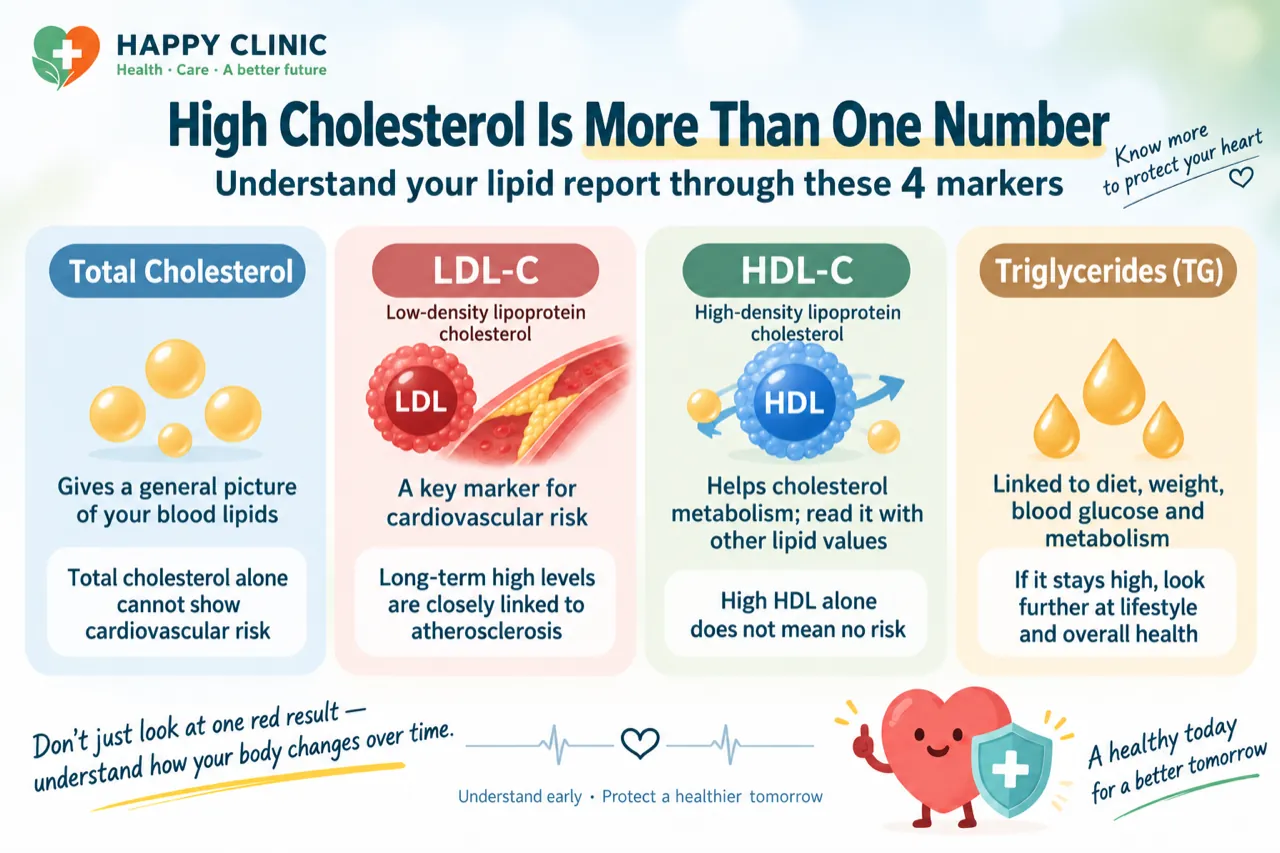
A complete lipid assessment usually looks together at total cholesterol, low-density lipoprotein cholesterol (LDL-C), high-density lipoprotein cholesterol (HDL-C) and triglycerides (TG).
More importantly, these numbers need to be assessed in the context of the person's age, blood pressure, blood glucose, smoking status, weight, kidney health, family history, and whether they already have cardiovascular disease.
So when you see a red cholesterol result, the first step is not to panic, but to properly understand your lipid report.
What do the 4 numbers on a lipid report mean?
1. Total cholesterol
Total cholesterol gives a general idea of your overall lipid status, but it is made up of cholesterol carried by different lipoproteins, so a person's cardiovascular risk cannot be judged from total cholesterol alone.
Some people have a high total cholesterol, but once it is broken down into LDL-C, HDL-C and TG, the degree to which they actually need to be concerned may differ.
Total cholesterol is therefore more like a "warning light": once it comes on, you need to look further inside.
2. LDL-C: a lipid marker that deserves particular attention
LDL-C is commonly called "bad cholesterol".
The name is easy to understand, but what really matters is this: if LDL and other ApoB-containing lipoproteins remain too high in the blood over the long term, they can enter the artery wall and contribute to the formation of atherosclerotic plaque.
Current medical evidence regards LDL-C as an important causal factor in atherosclerotic cardiovascular disease, so lowering LDL-C is one of the key directions in managing cardiovascular risk.
But not everyone has exactly the same LDL-C target.
For people who already have cardiovascular disease, diabetes or chronic kidney disease, or who are at higher cardiovascular risk, the standards a doctor uses will differ from those for the general low-risk population.
So with LDL-C, it is not enough to ask "Is it above the normal range?" You also need to ask:
"Given my overall health, what does this number mean?"
3. HDL-C: higher is not necessarily safer
HDL-C is often called "good cholesterol".
But health management cannot be simplified to: high HDL = safe, so high LDL does not matter.
HDL-C is one part of the lipid assessment and still needs to be interpreted together with LDL-C, triglycerides and other cardiovascular risk factors.
So do not ignore other lipid abnormalities just because your HDL-C looks good.
4. Triglycerides (TG)
Triglycerides are another item on the lipid report worth paying attention to.
They can be affected by diet, weight, alcohol, blood glucose control, metabolic status, and certain diseases or medications.
If TG remains high, it should not simply be put down to "eating too much fatty food lately"; you should look further into your diet, blood glucose, weight and overall metabolic health.
Can you feel high cholesterol?
Lipid abnormalities often have no obvious symptoms in the early stages.
There may be no chest pain or dizziness, and being slim or exercising regularly does not guarantee you have no lipid problems.
That is why many people only discover abnormal LDL-C or triglycerides for the first time after a routine health check-up blood test.
This is also why we often remind people: feeling fine does not mean the numbers do not need to be understood.
Why has my cholesterol gone up?
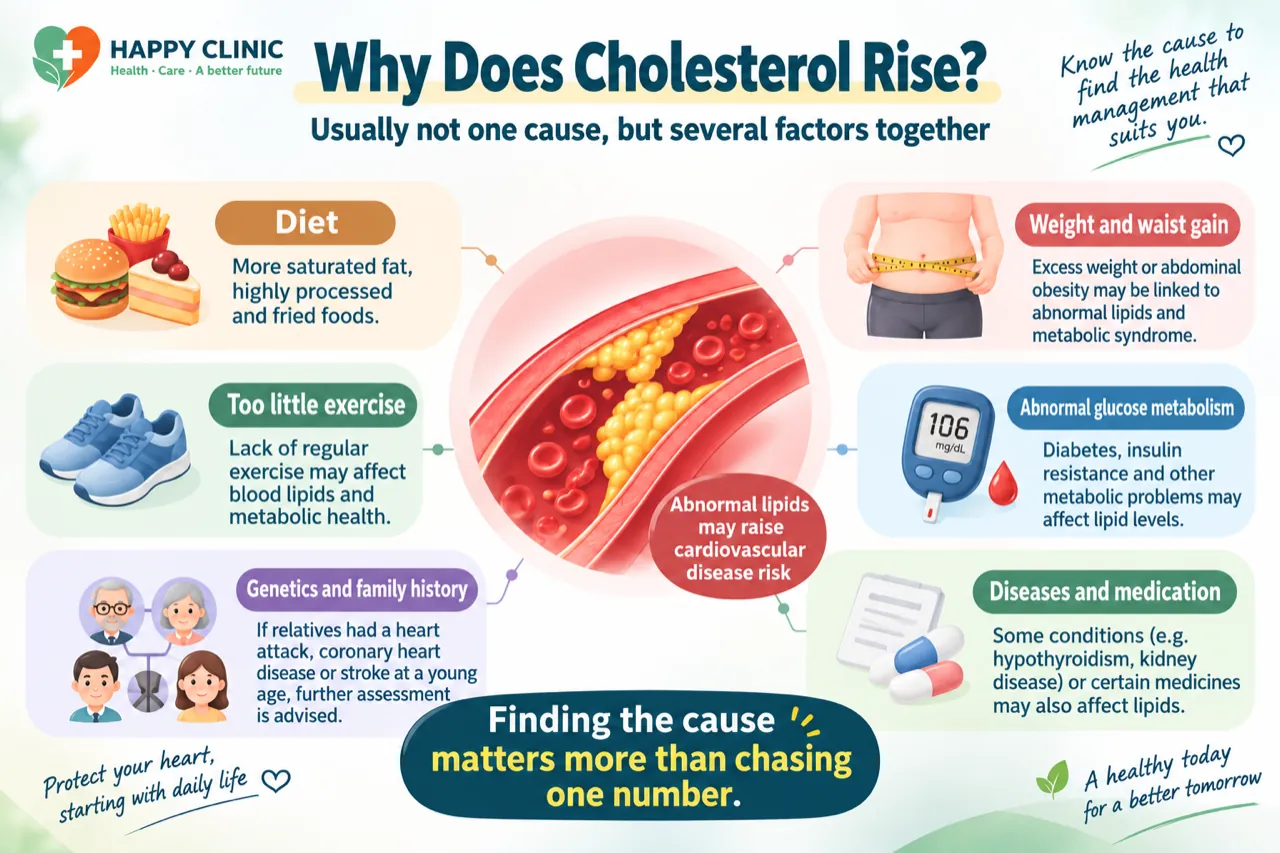
Abnormal cholesterol is usually not caused by a single factor.
Common factors that need to be assessed together include:
- A diet high in saturated fat
- Increased weight and waist circumference
- Not enough physical activity
- Abnormal blood glucose or metabolic status
- Alcohol
- Age and hormonal changes
- Genetics and family history
- Certain diseases
- Certain medications
So two people with the same high LDL-C may have completely different causes and health risks.
If LDL-C is particularly high, or family members have had a heart attack, coronary heart disease or stroke at a relatively young age, possibilities such as familial hypercholesterolaemia should also be included in the professional assessment.
With high cholesterol, can you no longer eat egg yolks, meat and seafood?
There is no need to remove every egg, piece of meat or seafood from your table the moment you see a red cholesterol result.
What really needs attention is your overall dietary pattern.
Rather than focusing on any one food, it is more worthwhile to review whether you regularly eat a lot of saturated fat, highly processed foods and fried foods, and whether your overall calorie intake is too high.
You can start with practical lifestyle changes: cut down on foods high in saturated fat and highly processed foods, eat more vegetables, whole grains and protein sources that suit you, and keep up regular activity and a healthy weight.
Diet is not as simple as "eat one egg today and your cholesterol rises tomorrow". What is really worth managing is your long-term lifestyle.
Does high cholesterol always need medication?
Not necessarily.
Whether lipid-lowering medication is needed cannot be decided from a single red total cholesterol result on a health check-up.
Doctors usually consider the LDL-C level, overall cardiovascular risk, and whether there is diabetes, chronic kidney disease, known atherosclerotic cardiovascular disease or other important risk factors, before deciding whether medication is needed and what the appropriate management target is.
If you are already taking lipid-lowering medication, do not stop, reduce or change it on your own just because one result has returned to normal.
An improved number is sometimes exactly the sign that treatment and lifestyle changes are working.
Beyond LDL, what else is worth looking into?
For some people with a family history, higher cardiovascular risk, or risk that a standard lipid test cannot fully explain, a doctor may assess other markers.
For example, lipoprotein(a), or Lp(a), is now also regarded as a marker worth attention in cardiovascular risk assessment.
But not everyone with high cholesterol needs to go through every advanced test.
It is also important to distinguish that blood lipids reflect values at the blood and metabolic level, whereas immune cell testing and mitochondria and cellular energy look at the cellular level. They answer questions at different levels and cannot replace one another.
More tests are not necessarily better; what matters is knowing why you are being tested.
A reminder from Happy Clinic: don't just deal with one red number
When cholesterol is abnormal, the question we really want to answer should not only be: "How do I bring this number down?"
We should also look further at:
LDL-C → HDL-C → triglycerides → blood glucose → blood pressure → kidney function → weight and waist circumference → diet and lifestyle → medications → long-term changes
Because health management is not just about turning a red figure on one report back to black.
It is about understanding why these numbers have changed, and what they mean for your own body.
Don't just look at the red figures from one check-up; understand how your body changes over time.
Important note
This article provides general health education information and cannot replace a doctor's diagnosis or individual medical advice. Lipid targets, whether medication is needed, and how to adjust diet and lifestyle should be assessed by a doctor based on your individual cardiovascular risk and overall health. If you are already taking lipid-lowering medication, do not stop, reduce or change it on your own.
References
- 2025 Focused Update of the 2019 ESC/EAS Guidelines for the Management of Dyslipidaemias. European Heart Journal. 2025.
- American Heart Association, Cholesterol and Cardiovascular Risk.
- Health Promotion Administration, Ministry of Health and Welfare (Taiwan). Health education materials on dyslipidaemia and cardiovascular health.
FAQ
Does high total cholesterol mean my arteries are blocked?
Not necessarily. Total cholesterol is only one part of a lipid assessment and cannot on its own show whether there is atherosclerosis or arterial blockage. You should look further at LDL-C, HDL-C, triglycerides and your overall cardiovascular risk.
Is lower LDL-C always better?
LDL-C management targets need to be judged according to individual cardiovascular risk. People who already have cardiovascular disease or are at high risk may have different targets from the general low-risk population, so this should be assessed by a doctor case by case.
If my HDL-C is high, do I not need to worry about LDL-C?
No. HDL-C is only one part of the overall lipid assessment, and a higher HDL-C cannot offset LDL-C or other cardiovascular risk factors.
Can supplements alone improve high cholesterol?
Supplements are not recommended as a substitute for professional assessment, lifestyle changes or necessary medical treatment. Whether further management is needed should be based on lipid levels and individual overall risk.
If my numbers are normal after taking cholesterol-lowering medication, can I stop it myself?
Stopping or adjusting the dose on your own is not recommended. Improved numbers may be the result of lifestyle changes or the medication working. Whether to continue, adjust or change medication should be assessed by a doctor based on your situation and follow-up results.
Want to know how your body is doing right now?
A regular health check-up mostly shows results as numbers. Happy Clinic’s precision health testing looks at your body at the cellular level, as a reference for health management.
- 15 precision health tests covering immune, telomere, mitochondrial and metabolic aspects
- Our professional team compiles the results and explains the next steps for health management
- Whether a test is suitable needs to be assessed by a doctor based on your individual health
More in Health Testing
Keep reading on related topics