
What Is Immune Cell Testing? Understanding Your Immune Status Through an Immune Cell Map
TL;DR
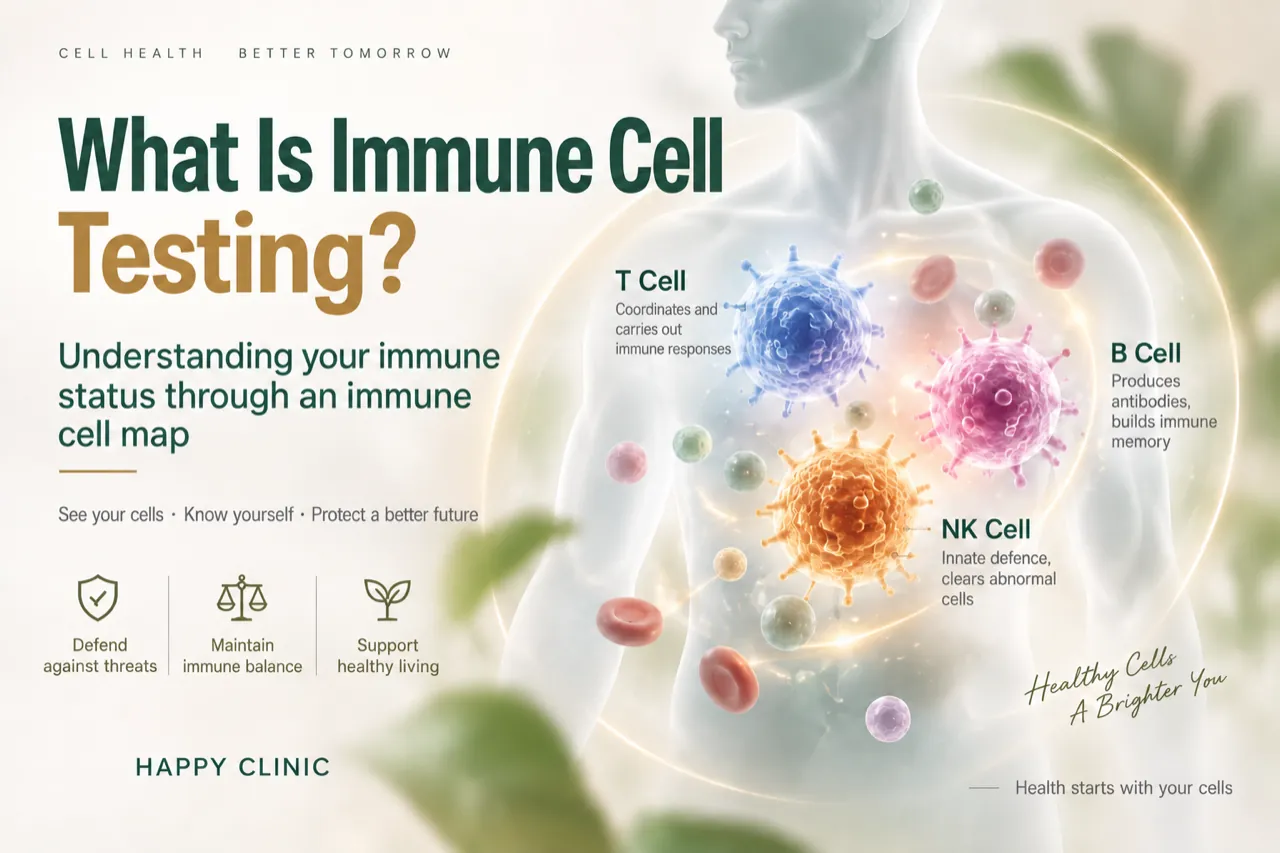
- Immunity is not a single number; the immune system is made up of different cells such as T cells, B cells and NK cells.
- Immune cell testing (immunophenotyping) uses flow cytometry to look at the composition, proportions and distribution of different immune cell populations.
- A routine white blood cell differential and immune cell analysis answer questions at different levels and cannot replace each other.
- More NK cells is not necessarily better; immune cell data needs to be interpreted together with age, medical history, symptoms and other tests.
- General immune cell testing cannot diagnose cancer on its own, nor can it replace a routine health check-up.
Contents
- Why are they called "immune cells"?
- What are the important immune cells in the body?
- Routine blood tests already show white blood cells, so why look at immune cells?
- What is an "immune cell map"?
- How are immune cells "seen"?
- What does immune cell testing mean for health management?
- Why can't you rely on a single result?
- Can immune cell testing replace a routine health check-up?
- Can immune cell testing tell me whether I have cancer?
- From "organ health" to "cellular health"
- Professional information and technical collaboration
- Important note
- References
We often talk about "immunity", but immunity is not actually a single number.
The human immune system is made up of many different types of cells. Every day they recognise, monitor, respond, clear and regulate within the body, each with its own role, while also working together.
So when we want to understand a person's immune status, beyond the traditional white blood cell count and biochemistry tests, we can also use "immune cell testing (immune cell profiling / immunophenotyping)" to look further at the composition and distribution of the different immune cell populations in the blood.
It is like opening up a report that originally only said "white blood cells" and taking a closer look at the different cell members inside.
Why are they called "immune cells"?
Immune cells are key members of the body's immune system.
Every day the body comes into contact with microorganisms, viruses and other foreign substances in the environment, and it also continuously produces ageing or abnormal cells.
The immune system needs to recognise different signals and decide when to mount a response, and when to regulate or stop it.
And this work is not done by a single type of cell.
Many different immune cells can be found in the peripheral blood. Among the ones people hear about most often are:
- T cells
- B cells
- NK cells (natural killer cells)
With further analysis, T cells can be divided into CD4⁺ T cells, CD8⁺ T cells, and other cell subsets examined depending on the purpose of the test.
So what we usually call "immunity" is in fact a highly complex network of cells, and cannot be understood simply as "high" or "low".
What are the important immune cells in the body?
1. T cells: key coordinators and effectors of the immune system
T cells are key members of adaptive immunity.
In flow cytometric analysis, CD3 is one of the markers commonly used to identify T cells; other cell markers can then be used to distinguish different T cell subsets.
Common ones include:
CD4⁺ T cells
Involved in coordinating and regulating immune responses, helping other immune cells carry out an appropriate immune response.
CD8⁺ T cells
Have cytotoxic functions, and can recognise and mount an immune response against certain abnormal or infected cells.
Even among T cells, further subdivision is possible according to maturation stage, activation status, memory phenotype and other characteristics.
So "T cells" is actually a very large family of immune cells.
2. B cells: key players in antibodies and immune memory
B cells are key members of humoral immunity.
When B cells receive the appropriate stimulation, they can differentiate further and take part in antibody production and immune memory.
And there is not just one kind of B cell.
Depending on their maturation stage and cell phenotype, different B cell populations can be distinguished.
So an in-depth B cell analysis can provide more cell-level information than simply knowing "how many B cells there are".
3. NK cells: key members of innate immunity
NK cells, short for natural killer cells, are key members of the innate immune system.
NK cells are able to recognise and eliminate certain abnormal cells, and also take part in the body's immune responses through various signals.
But there is one very important point:
"More NK cells does not mean better immunity."
NK cells themselves have different subsets, and their function is regulated by a variety of activating and inhibitory signals.
So cell numbers, proportions and actual function cannot be reduced to the same thing.
Routine blood tests already show white blood cells, so why look at immune cells?
This is a question many people ask when they first come across immune cell testing.
The CBC (complete blood count) in a routine health check-up is very important, giving basic information on white blood cells, red blood cells, platelets and more; the white blood cell differential further shows the proportions of lymphocytes, neutrophils and others.
But "lymphocytes" actually include different cell populations.
For example:
Lymphocytes
↓
T cells
B cells
NK cells
And T cells can be further divided into:
- CD4⁺ T cells
- CD8⁺ T cells
- Other cell subsets analysed further for different purposes
So routine blood tests and immune cell analysis do not replace each other.
They answer questions at different levels.
Routine blood tests provide important baseline information; immune cell analysis goes further, looking at the composition of different immune cell populations.
What is an "immune cell map"?
If you think of the body's immune system as a large team, knowing only "how many people the company has in total" is clearly not enough.
We would also want to know:
- Who coordinates?
- Who carries out the work?
- Who remembers?
- Who produces antibodies?
- Who regulates?
Immune cells are the same.
So what we call an "immune cell map" can be understood as using different cell markers to tell different immune cell populations apart, and then looking at their composition, proportions, numbers or specific phenotypes.
It is not an "immunity report card".
It is better understood as a more detailed "map of immune cell distribution".
How are immune cells "seen"?
Many immune cells look very similar, and they are not easy to distinguish precisely by appearance alone.
This is where an important technology comes in:
"Flow cytometry"
Different immune cells carry different cell markers.
For example, in common immunophenotyping:
- CD3: T cell-associated marker
- CD4: CD4⁺ T cell analysis
- CD8: CD8⁺ T cell analysis
- CD19/CD20: B cell-associated analysis
- CD16/CD56: NK cell-associated analysis
The laboratory can use antibodies carrying different fluorescent signals to identify these cell markers, and then use a flow cytometer to analyse large numbers of cells one by one.
In this way, within what was originally a mixed population of cells, different immune cell populations can be identified according to combinations of markers.
What does immune cell testing mean for health management?
The greatest value of immune cell testing is not telling someone:
"Your immunity scores 80."
Rather, it provides information at another level:
"What composition and distribution do the different immune cell populations currently show?"
Depending on the test panel and analytical method actually used, the main immune cell populations such as T cells, B cells and NK cells can be examined, and specific cell subsets may also be analysed further according to the purpose of the test.
Immune cell testing therefore takes health information from "how many white blood cells are in the blood" further, to "which different immune cells make up those white blood cells".
This is the key difference that cell-level health information makes.
But the immune system is highly complex, and test results still need to be understood together with age, medical history, symptoms, medication use and other test results.
Why can't you rely on a single result?
The body's immune status is not fixed.
Infection, medication, lifestyle and other physiological factors can all affect some immune cell data.
So where there is an appropriate need for follow-up, comparing results before and after using the same test method under appropriate conditions can sometimes make trends easier to understand than looking at a single result alone.
This is also a very important principle of cellular health management:
"Not just asking whether something is normal, but beginning to understand how your cells change."
Can immune cell testing replace a routine health check-up?
No.
Biochemistry tests, routine blood tests, imaging and immune cell analysis each provide different kinds of information.
Put simply:
Biochemistry tests
Show the body's current biochemical markers.
Routine blood tests
Show blood cell counts and basic classification.
Imaging
Looks at the structure of organs and tissues.
Immune cell testing
Looks at specific immune cell populations at the cellular level.
Truly complete health management is not about choosing one type of test to replace all the others, but about bringing meaningful information together based on your individual health.
Can immune cell testing tell me whether I have cancer?
Cancer cannot be diagnosed by general immune cell testing alone.
Likewise, seeing that a particular T cell, B cell or NK cell figure is high or low does not allow you to conclude directly that you have a certain disease.
Flow cytometry tests for different purposes use different panels, analytical methods and interpretation criteria.
So "using flow cytometry" does not mean that every disease can be found through the same test.
The right approach is:
"First understand which health question you want to answer, then choose the appropriate test."
From "organ health" to "cellular health"
Traditional health check-ups let us understand the body through organs, blood and biochemical values.
Now, cell analysis technology offers another window.
Immune cells are only the beginning.
Going further down to the cellular level, we can gradually learn about:
- Telomeres and cellular ageing
- Mitochondria and cellular energy
- Haematopoietic stem cells (HSC)
- Mesenchymal stem cells (MSC)
- Tregs and immune regulation
- B cells and different cell subsets
This information is not meant to replace doctors, nor to predict the future from a single cell figure.
It is about beginning to understand our bodies at different scales.
"Health starts with understanding your body, and understanding your body can start with understanding your cells."
Professional information and technical collaboration
This article was compiled by the Happy Clinic health management team.
Technical content related to cell testing was provided through professional information and technical collaboration from Neogenesis Biotech.
Actual test items, sample requirements, suitability and interpretation of results should be assessed according to individual health and by medical professionals.
Important note
This article provides general health education information and cannot replace a doctor's diagnosis or individual medical advice. Who immune cell testing is suitable for, which tests to choose and how to interpret results should be assessed by medical professionals based on individual health, medical history and the purpose of testing. If you have recurrent infections, unexplained fever, long-term fatigue or other health concerns, please seek medical care early, and do not draw your own conclusions from test data or delay diagnosis and treatment.
References
- McKinnon KM. Flow Cytometry: An Overview. Current Protocols in Immunology. 2018.
- Farmer JR, DeLelys M. Flow Cytometry as a Diagnostic Tool in Primary and Secondary Immune Deficiencies. Clinics in Laboratory Medicine. 2019.
- Boldt A, et al. Eight color immunophenotyping of T-, B- and NK-cell subpopulations for characterization of chronic immunodeficiencies. Cytometry Part B: Clinical Cytometry. 2014.
- Mayo Clinic Laboratories. Quantitative Lymphocyte Subsets: T, B, and NK, Blood.
FAQ
Does immune cell testing measure "immunity"?
Not exactly. The immune system includes many different cells and functions and cannot be reduced to a single "immunity score". Immune cell analysis mainly provides information on the number, proportion or phenotype of specific immune cell populations.
What is the difference between T cells, B cells and NK cells?
They play different roles in the immune system. T cells are involved in cell-mediated immunity and immune regulation; B cells are closely linked to antibodies and immune memory; NK cells are key members of the innate immune system.
Are more NK cells better?
No. Immune cells cannot be judged simply by "the higher the better"; results must be interpreted comprehensively according to the test method, reference information and individual health background.
If my routine health check-up is normal, do I still need immune cell testing?
Not necessarily. Whether further testing is needed should be decided based on individual health, the purpose of testing and professional medical assessment.
Can immune cell testing diagnose disease?
Specific, validated immunophenotyping tests have clinical uses in diagnosing or monitoring certain diseases, but general immune cell testing should not be regarded as a screening tool for all diseases. Results still need to be interpreted alongside other clinical information.
Can I track my immune cells regularly?
Follow-up is possible where there is an appropriate purpose and professional assessment. If you want to compare changes over time, consistency in sample collection conditions, test method and analysis is also important.
Want to know how your body is doing right now?
A regular health check-up mostly shows results as numbers. Happy Clinic’s precision health testing looks at your body at the cellular level, as a reference for health management.
- 15 precision health tests covering immune, telomere, mitochondrial and metabolic aspects
- Our professional team compiles the results and explains the next steps for health management
- Whether a test is suitable needs to be assessed by a doctor based on your individual health
More in Health Testing
Keep reading on related topics